





Eye For Film >> Movies >> The History Of Sound (2025) Film Review


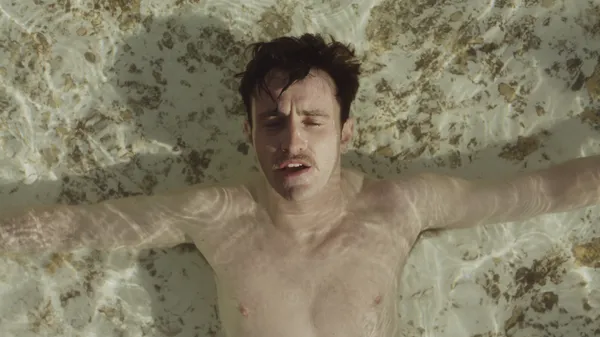

Have you ever thought about why Luca Guadagnino succeeded with Call Me By Your Name, despite occasional transgressions against common sense (the father’s monologue later in the film) and good taste (the bicycle exiting the frame down the curvy path in a minutes-long single static shot)? The answer is the perfect calibration of how far he could go with the explicit where it mattered most, and when it was the right time to put on the brake. Through insinuations he achieved the effect of constant teasing and the impression of courage without actually risking anything close to an X-rating or even bad publicity. Compared to Call Me By Your Name, the once seen as revolutionary Brokeback Mountain now seems relatively tame and decent in a cowardly way. But what should we do when we get a Brokeback Mountain-style film in the time after Call Me By Your Name, which is the case with Oliver Hermanus’ The History of Sound?
Initially, what we see does not match what we hear, as the raspy-voiced narrator (Chris Cooper) talks about his childhood in rural Kentucky, while we watch the boy (Leo Cocovinis) playing on the edge of some woods, but we sense that they are the same person. Old Lionel tells us his talent for anything connected to music lifted little Lionel from poverty and propelled him to Boston to study singing at the Conservatory. There, one night in the bar, he (Paul Mescal takes over the role from here) heard a song that sounded familiar sung by a man at the piano. That man, David (Josh O’Connor) is an aspiring composer and a musicologist with a special taste for folk songs. Sparks fly, but it is 1917, so that kind of love is strictly forbidden.

And, since it is 1917, David gets drafted into the US Army and shifted to Europe to fight in the First World War. Meanwhile Lionel, “protected” by his spectacles from such destiny, has no other choice than to go home to his mother (Molly Price), father (Raphael Sbarge) and grandfather (Tom Nelis) – where we realise that Mescal is more than a tad too old for the role. David comes back from overseas, but shattered. Luckily, three years later, he finds employment and his college tasks him with recording old folk songs in the backwoods of Maine, so he thinks of his college friend with whom he shares a passion for folk music, and the two go on a camping trip during which they share intimate moments. After that they go their own way, never to meet again, and we stay with Lionel, perspective-wise, as he tries to figure out what happened to the relationship and to a man he loved.
A fellow metalhead friend of mine once expressed the theory that if the eighth song on a certain album is good, then the whole album is good. The theory was rooted in pure phenomenology and personal observations, but somehow it works. Relying on that, my theory is that bands usually pack the first half of their album with hits made with a lot of passion or at least precise insight into what might work for the audience, while the second half is mostly “filler” songs, before maybe ending on a high note. That practice might have made sense in the age of LPs and cassettes with A and B sides, but, from the age of CDs on, that grouping style is counter-productive.
The History Of Sound suffers from the same problem – most of the filmmaker’s passion, wisdom and wits is packed in the first half, while the second half represents pure “production” of content. To use another music metaphor, The History Of Sound is as safe as a radio-friendly pop, glam rock or lite electronica, competently done, but calculated and slightly heartless.
The “vocals” (the actors) are good, although one of them tries to fake a younger “voice” for far too long, and the other one disappears from the half of the “album” only to be missed until the end. The base rhythm section (editing) is dictated by the source material and the director’s desire to drag an adaptation of a short story into the territory of an adaptation of an epic novel means the tempo is constantly locked in “moderato” speed, at best. The core guitars and pianos (cinematography and production values) are good, but not outstanding, while the orchestral flourishes (period details) feel underplayed. We could say the same for the rest of Hermanus’ career, but the discretion of Beauty (2011), Moffie (2019) and especially Living (2022) was in place because those films did not deal with passion, but with the pressure of society, resilience, intolerance, decency and stoicism.
Curiously, both the writer and the filmmaker here seem to be passionate only about music, just like their characters. When we tune in to the sounds of American, English or Irish folk tunes in different registers of emotions, The History Of Sound starts sounding lively and passionate. But one single component cannot be ridden until the bitter end and even then, it cannot save the film from its own safe mediocrity. Especially when the key component, the romance, never properly works.
Reviewed on: 26 Nov 2025


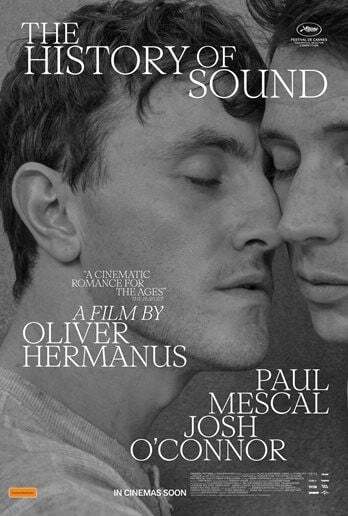

Director: Oliver Hermanus
Writer: Ben Shattuck
Starring: Paul Mescal, Peter Mark Kendall, Josh O'Connor, Chris Cooper, Molly Price, Raphael Sbarge, Hadley Robinson, Emma Canning, Briana Middleton, Alessandro Bedetti, Will Fitz, Gary Raymond, Alison Bartlett, Michael D. Xavier, Dan Bittner
Year: 2025
Runtime: 127 minutes
Country: US
Search database: